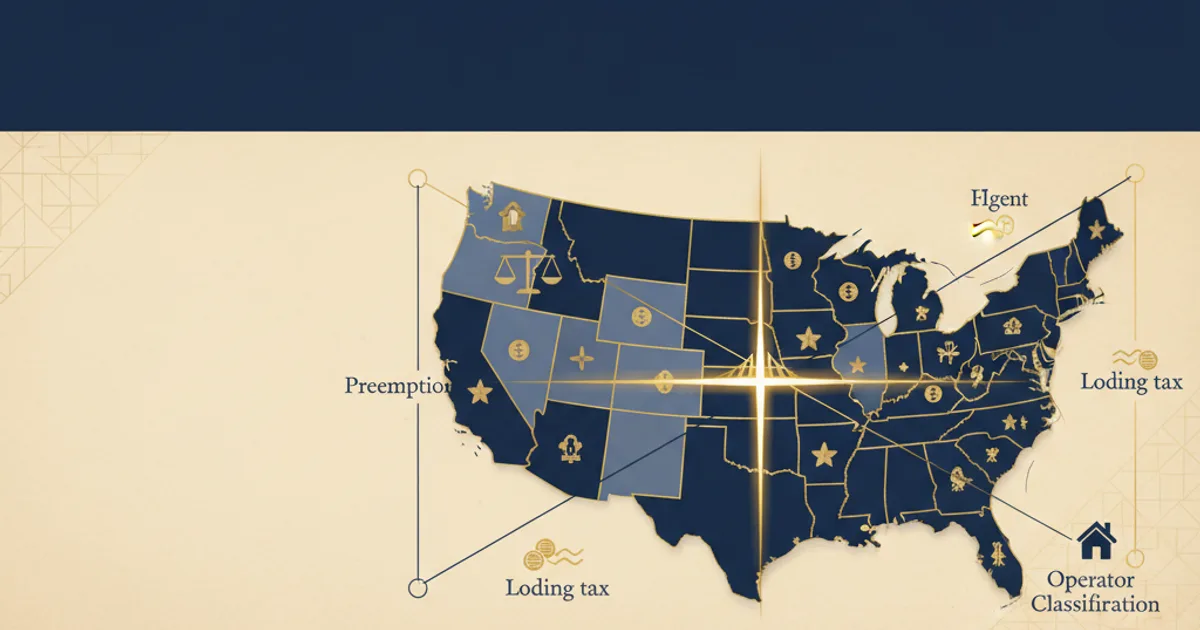
Short-term rental laws vary state to state on three axes — preemption, lodging tax, and operator classification. Here's the 50-state map of which rules ride at the state level and which drop to the city.
Short-term rental laws in the US are layered. Federal tax rules apply everywhere. State rules either preempt cities, layer on top of cities, or leave the field entirely to local government. City rules — where they exist — do the heaviest lifting on permits, caps, and zoning.
This guide is the state-level map: what each US state does and does not regulate, the three patterns states use, and what changes for operators when you move a rental across a state line.
The three state-level patterns
Pattern A — Preemption states. The state legislature has passed a law saying cities and counties cannot ban short-term rentals or impose “unreasonable” restrictions. City ordinances exist but are often limited to nuisance, health, and safety. Investor-friendly. Less predictable in the long run because the preemption can be repealed in a single legislative session.
Pattern B — Permission states. No state law specifically on STRs; cities and counties operate freely under their normal zoning and business-licensing authority. This is most states. The actual regulation lives at the city level — see Do You Need a Permit for Your Airbnb?.
Pattern C — Restrictive states. State law adds operator requirements (lodging tax registration, agent-of-process designation, mandatory insurance) on top of whatever cities require. Often combined with state-level fines for non-compliance. Hawaii and New York are the strongest examples.
State lodging tax
Every state with sales tax also taxes lodging — either as a percentage of nightly rate (most common) or as a flat per-night charge (a few rural counties). Even in states with no income tax (Texas, Florida, Washington, Tennessee, Nevada, Wyoming, South Dakota, Alaska, New Hampshire), lodging tax applies.
| Region | Typical lodging tax range (state + local combined) |
|---|---|
| Mountain West (CO, UT, MT, ID, WY) | 8%–13% |
| Pacific Coast (CA, OR, WA) | 10%–17% |
| Northeast | 9%–15% |
| Southeast | 7%–14% |
| Texas/Oklahoma/Louisiana | 7%–17% |
| Hawaii | 14%–18% (TAT + GET + county) |
Two things to know about state lodging tax:
-
Airbnb and Vrbo collect and remit some state taxes for you but not all. They almost always collect state sales tax. They sometimes collect county/city occupancy tax. They rarely collect tourism improvement district or special-purpose taxes. Check your tax dashboard before you assume.
-
You typically still have to register with the state Department of Revenue even when the platform remits. The registration is for the property; the remittance is for the platform. Without registration, an audit finds you operated unregistered for the full lookback period.
Operator classification at the state level
A handful of states classify STR operators specially:
- Hawaii — TVR (Transient Vacation Rental) license required statewide, separate from county permits
- Florida — DBPR Vacation Rental License required statewide; cities layer on top
- Maine — Lodging tax registration with the state plus city registration in towns over 4000
- Colorado — Standard sales tax license is required; some counties (Summit, Eagle) add countywide license
Most other states treat the STR as a normal small business — you register a DBA or LLC, get a sales tax permit, comply with city permit, done.
State preemption: who’s done it and what it actually means
Preemption isn’t an on/off switch. It’s a spectrum. Five states have meaningful preemption laws as of 2026:
Arizona (SB 1350, 2016, with 2019 amendments) — Cities can require permits, regulate noise and trash, but cannot ban STRs or limit them by zoning class beyond what applies to long-term rentals. Scottsdale and Sedona have tested the edges. Investor-friendly.
Florida (Statute 509.032(7)) — Cities cannot pass new STR ordinances; ordinances passed before June 2011 are grandfathered (Miami Beach is the famous example). Periodic legislative attempts to expand or repeal preemption — track the most recent session.
Texas (Bohannan v. Austin, 2019) — A Texas Supreme Court ruling held that Austin’s permit-cap ordinance violated state law. Practical effect: most Texas cities now operate registration-only programs; permit caps and outright bans face high legal risk. Houston, Dallas, San Antonio all light-touch.
Indiana (HB 1035, 2018) — Cities cannot ban STRs in residential zones; can require registration and impose nuisance rules.
Tennessee (TCA 13-7-602, 2018) — Cities cannot ban STRs in single-family residential zones in properties used as short-term rentals before 2017 (grandfather). Nashville has heavily contested the limit; new properties in Davidson County face the city’s owner-occupied rule. Outside Nashville, very light.
The “ban” states (or, where cities have effectively banned STRs)
A handful of cities have moved from “regulate” to “ban or effectively ban” — and they sit in non-preemption states, so the bans hold:
- New York City (NY) — Local Law 18 (2023): hosts must register; registration requires owner presence during the rental; effectively bans non-hosted STRs under 30 days. Number of legal listings dropped from ~22,000 to under 2,500.
- Honolulu (HI) — Bill 41 (2022): minimum 90-day stay outside designated resort zones. Most Oahu STRs operating under 30 days are no longer legal.
- Santa Monica (CA) — Owner must be present for rentals under 30 days. Hosted-only model.
- San Francisco (CA) — Permit required; owner must reside in unit 275+ nights/year; cap at 90 unhosted nights/year.
- Los Angeles (CA) — Home-sharing ordinance: owner-occupied required; 120-night cap on unhosted operation.
What “effective ban” usually means in practice: the legal STR universe shrinks 70–95% from peak, the secondary-market price of legal permits spikes (where transferable), and the remaining legal operators run higher-priced, lower-volume hosted listings.
Cross-border move: what changes
When you move (or buy) an STR across a state line, four things change:
- Lodging tax rate — rebuild your pricing model. A move from a 7% tax state to a 17% tax state can take 8 points off your gross margin if you absorb it.
- Permit pathway — registration-only vs CUP vs cap vs ban. Affects time-to-launch and capital allocation.
- State-level operator license — Hawaii TVR, Florida DBPR, Colorado sales tax, Maine lodging registration. Add 30–60 days to launch.
- Insurance market — STR insurance is state-licensed; your current carrier may not write in the new state. Confirm before close. Proper Steadily
Federal tax treatment (the tax loophole, depreciation rules, Schedule E vs C classification) does NOT change state to state. Those rules ride at the federal level.
The state-level decision matrix for new operators
Capital is mobile. You haven't bought yet. Which state?

High capital + comfort with longer permit timelines + strong rental demand:
  → Tennessee (Nashville is hard, rest of state easy), South Carolina,
    Florida (with preemption hedge), parts of Texas

Low-touch regulation + investor-friendly + decent demand:
  → Arizona, Indiana, most of Texas outside Austin, rural Colorado

Maximum legal certainty + willing to operate at lower-volume hosted model:
  → Most of the Mountain West outside resort towns,
    Mid-Atlantic outside city cores, most of the rural Northeast

Avoid unless you have a specific play:
  → New York City, Honolulu, Santa Monica, most of coastal California,
    Hawaii outside resort zones, urban core of any city that has
    moved to "ban or effective ban"
Where the state law changes mid-year
State legislatures pass STR-related bills almost every session. Recent active areas (2024–2026):
- Florida — repeated attempts to expand or repeal preemption
- California — statewide minimum standards bills, debated annually
- Hawaii — county-level expansions of the Bill 41 model
- Texas — attempts to codify Bohannan and prevent municipal bans
- New York — companion bills extending Local Law 18 statewide
If you operate in any of these states, get a free alert from STRLaws when your state or city updates its STR rules. The rules can change in a single 60-day session and grandfather provisions vary widely — you want the change the day it lands, not the next time you happen to check.
Where STRLaws helps
For the city-level rules that sit on top of state law — and which do the heaviest lifting in most jurisdictions — see your state’s page on STRLaws. We track 500+ US cities and update weekly. For permit specifics see Do You Need a Permit for Your Airbnb?. For federal tax interactions, see Short-Term Rental Rules from the IRS.
This is an information service, not legal advice. State laws change. Confirm current rules with a licensed attorney in your state before buying or launching.